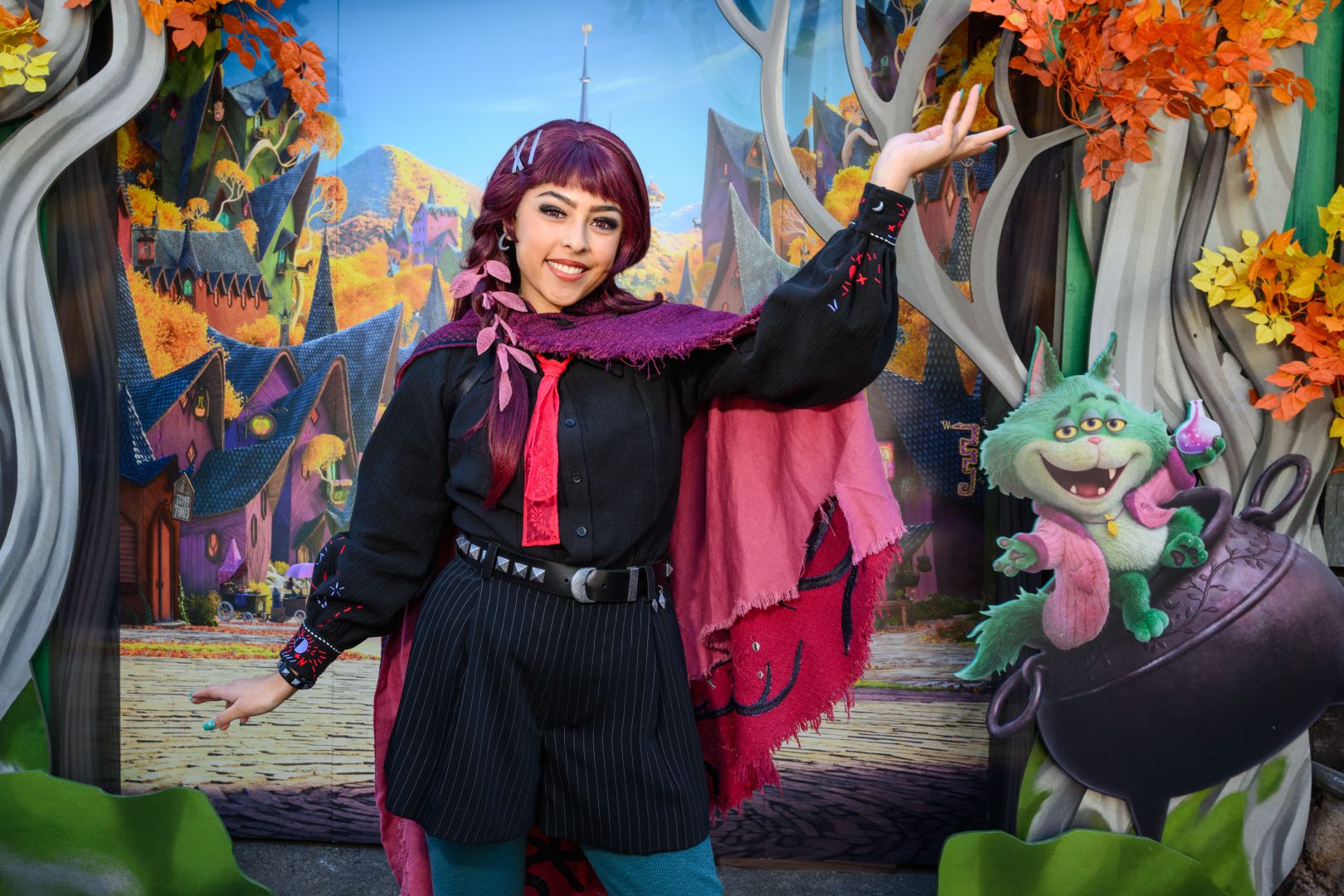
Just as audiences can see the full world of Disney’s Hexed from Walt Disney Animation Studios on screen, they’ll have another way to step inside it.
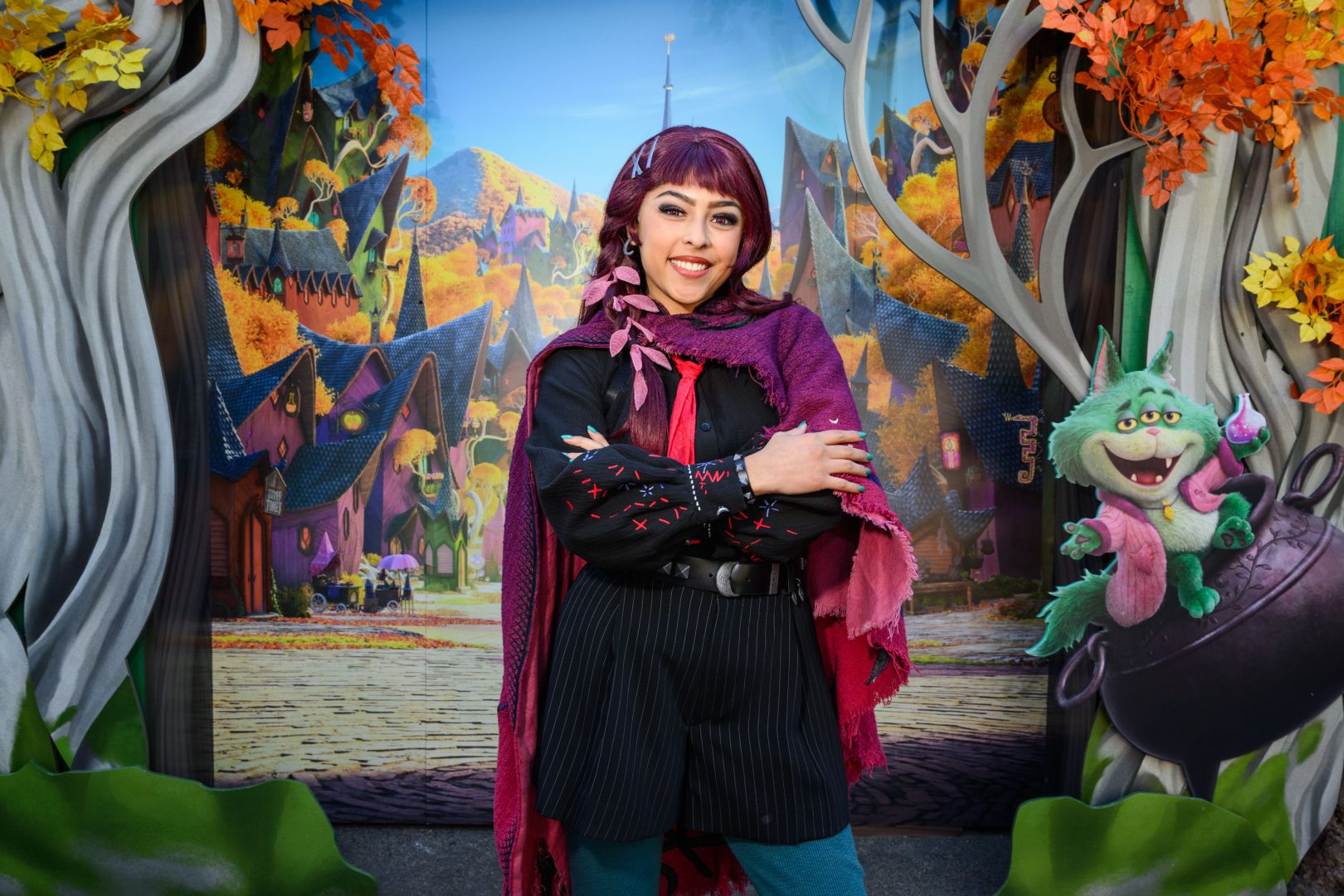
Billie Doe, the protagonist of the film — which comes to theaters today — is making select appearances greeting guests at Disneyland Park, where Disney Live Entertainment (DLE) has created an environment inspired by Hexe, the fantastical realm at the center of the story. Billie will also appear at The Magic of Disney Animation at Walt Disney World Resort, extending the character and her world from Disney Animation into Disney Experiences.
Bringing that world into a physical environment required close collaboration between the artists who created Disney’s Hexed and the teams tasked with translating it into something guests can encounter in person.
Lorelay Bové, production designer for Disney’s Hexed, and her team shared detailed design packets her team created for the film with DLE, giving the team a foundation for recreating elements originally developed for CG animation. The packets document everything from construction and fabrication to textures and color.
“Since so much detail is possible in CG animation, our design packets are very detailed and can even be realized and constructed in real life,” Bové said. “We shared those packets with the team, so they could have a better understanding of the final look. The DLE team is amazing and quickly found the right materials and details.”
At Disneyland, that translation from screen to physical space fell in part to Dan Torres, Sr. Art Director, Disney Live Entertainment, who helped design the backdrop that will surround Billie as she meets guests.
For Torres, the goal was to go beyond simply recreating an image from the film.
“The vision was this perspective that when you take your photo, it looks like you’re walking into Hexe,” Torres said.
Finding a Home for Hexe
Before the team could determine what the experience would look like, they first had to determine where it belonged.
The desire to place the experience near Fantasyland helped guide that search. The architecture and atmosphere of Hexe provided a natural thematic connection to the land, but finding the right location also meant accounting for the realities of an operating theme park, from existing guest areas and parade viewing to power and lighting. The team ultimately selected a location just outside Fantasyland along the pathway leading into it from Frontierland.
From there, Torres began exploring how to turn a relatively small footprint into a window onto a much larger world.
Working from materials provided by Disney Animation, the team ultimately evolved the portal concept around Billie Doe, creating the impression that she could lead guests into the world audiences had begun to glimpse through trailers for the film and a live experience at D23: The Ultimate Disney Fan Event over the summer.
That experience has an especially important role just as the movie reaches audiences.
“What I love about this one is that they get to engage with that character,” Torres said. “So the character gets to tell the story.”
For Bové, preserving that connection between the animated character and her physical counterpart is central to the experience.
“I hope that audiences feel all the love and care that goes into our movies,” Bové said. “Ideally, they will be touched to see the characters and settings in the park as authentically as they felt them in the film, creating a meaningful connection as the story transitions from the screen to real life. It is truly magical, and I believe they will feel a deeper familiarity with this world and its characters when they see Billie in the parks.”
Creating Depth
Turning that idea into a physical environment required some creative problem-solving. Torres and the team had to find ways to suggest a much larger environment within a compact footprint.
The solution started with trees. Three layers create incremental physical depth, while artificial foliage brings three-dimensional texture beyond the flat backdrop. Shadows, color saturation and the positioning of individual scenic pieces reinforce the illusion of distance. The installation also incorporates crows, including illuminated eyes, while audio from the film will play around the environment to add another layer of immersion.
The tree branches themselves were carefully considered. Rather than simply creating an ominous forest, the team thought about the branches almost as “caring hands,” using their shapes to frame the space and draw guests toward Hexe.
All of those choices serve one deceptively simple objective: making a flat image feel like somewhere guests could actually go.
“Anything I can do to make something three dimensional instead of just two dimensional,” Torres said.
The final design is the product of continual iteration. Concepts shifted as the team balanced creative ambition with considerations including space, infrastructure, guest circulation, timing and the physical environment of Disneyland Park. Even the artwork itself was adjusted to make the path into Hexe feel more natural at a human scale.
That process also illustrates the different challenges facing artists working in animation and those building for a physical environment. The level of detail developed for a CG character can help bridge those two forms: design decisions made for the screen become practical references for choices about real-world fabric, texture, color, and construction.
When a Story Can Live Anywhere
Billie Doe’s journey from an animated film into physical Disney experiences on both coasts represents something bigger than a character appearance.
Disney’s ability to tell stories across multiple consumer touchpoints allows a single story to move between screens and physical spaces, giving audiences different ways to experience the same characters and worlds. Across Disney, creative teams can build on stories through film and television, streaming, theme parks, consumer products, and more, extending storytelling well beyond the medium where it begins.
For Bové, that expansion is particularly meaningful after nearly four years working on the film.
“After the film is released and shared it is truly remarkable and fulfilling; it touches my heart seeing audiences and people connect with the world and characters,” Bové said. “It is also inspiring to see the other parts of the company come together to bring the world of Disney’s Hexed into something tangible and real.”
That interconnected creative ecosystem has been part of Disney storytelling since the earliest days of the company across consumer products and television, and was amplified with the arrival of Disneyland, where physical environments offered audiences a new way to step directly into stories and encounter characters, architecture, music, and narrative together.
For the people creating those experiences, collaboration across Disney can add new dimensions to the work. Torres has previously worked with Disney filmmakers on projects including Pixie Hollow and a Coco experience at Disneyland, which showed him how much richer a physical interpretation can become when creatives can understand not only what appears on screen, but the thinking and personal experiences behind those artistic decisions.
“The deeper you get with them, the better the design,” Torres said. “One of my favorite things to do here is collaborate with our film partners.”
It’s an opportunity that can open the door for even a relatively compact project to turn into a much larger story.
As Torres put it, there is a special challenge in designing “this little tiny thing that represents this massive thing.” And when those connections work, a story no longer has to exist in only one place. It can meet audiences in a theater, on a screen or, in this case, along a pathway into Fantasyland, where a little bit of physical space can become the beginning of a journey into another world.